
How Sportswashing blinds us
26 views · August 21, 2026 · 9 min read
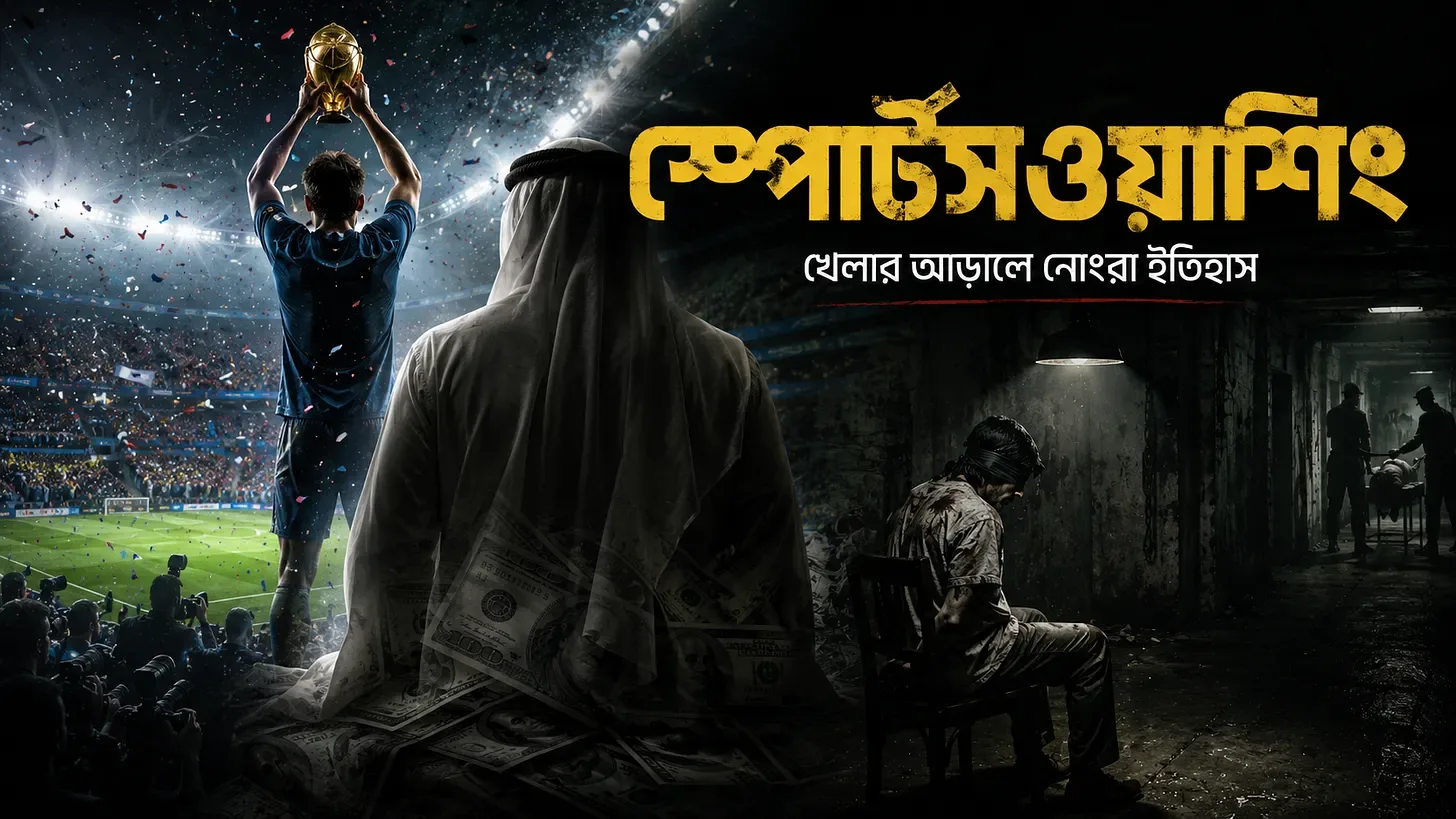
Football unites people — that is true. But it is also true that football keeps people blind. A history of how power has been exploiting this contradiction for centuries.
June 1978. The stands at the Estadio Monumental in Buenos Aires are roaring — Argentina is playing in the World Cup final. Confetti is flying, the national anthem is playing, and General Videla is ready to lift the trophy. A mile and a half away from this scene, in the basement of the ESMA naval base, people declared enemies of the state are being tortured. At that moment, the cheers of the stadium and the screams from the basement were both floating in the air of the same city. One was heard on every television in the world. The other was never recorded anywhere.
The story we love to tell about football — joy, competition, unity — has another story hidden just underneath it, almost always. And the real question of this piece is whether, once you know that second story, you can still enjoy the first one as innocently as before.
The modern version of bread and circuses
There was a saying in the Roman Empire — Bread and Circuses. Give people food, give them entertainment, and they won't ask any more questions. This formula was so effective that even after two thousand years it still works perfectly — only now, football has taken the place of the "circus".
There is a psychological reason behind this, which is very rarely discussed. Sports act on a specific part of our brain — where identity, tribe, and emotion blend together. When someone shouts while wearing a national jersey, they become one with the state in a way that no election speech or propaganda poster ever could. Those in power realized this truth a long time ago.
Mussolini's trophy, Mussolini's referee
The 1934 World Cup in Italy. Fascism in Europe was young then, but ambitious. Benito Mussolini knew that winning this tournament would be a kind of "proof" — that fascism works, that the Italian nation is superior. The refereeing in the semifinal against Austria was so one-sided that the Austrian captain later said they weren't playing against 11 men, but against 14. Italy won. Four years later, in 1938, Italy again — and this time the players were supposedly told directly that they must win, otherwise the consequences would not be good.
One thing is worth noting here — Mussolini didn't just "use" football, he made the results of football a part of the state's legitimacy. A win meant the victory of an ideology. This pattern proved to be so effective that in the next ninety years, almost every authoritarian ruler on earth — from the Soviet bloc to the Argentine junta, from Russia to the Gulf monarchies — applied this same formula in one way or another.
When a football match sparks a war
1969. Honduras and El Salvador — two small Central American countries that had had simmering tensions for years over border disputes and immigration. Three matches in the World Cup qualifiers — riots in each, violence in each. After the third match, El Salvador severed diplomatic ties, and four days later a military attack began. In history, this war is known as "The Football War" — which Polish journalist Ryszard Kapuściński described in his book.
But we must be careful here — a football match was not the reason for the war; it was the trigger. The tension that had built up for years found a bottleneck in the football match. This is actually more frightening — because it means if a society is sufficiently bitter deep down, then any occasion — even a game — can become the catalyst for an explosion.
Pelé: The diplomat who had no title
In 1961, the Brazilian government enacted a law declaring Pelé a “national treasure” — so that no foreign club could buy him. But this was not just a protective measure. Pelé had become Brazil’s most effective soft power asset. Wherever he went to play, he built a bridge of emotion — and Brazil’s diplomatic interests later walked across that bridge.
This is a critical moment, as it is the first time we see an individual player become a geopolitical tool of a state, without the need for propaganda posters or official statements. This pattern has returned today in a more complex form — when an entire football club becomes a branding project for a state.
A kilometer and a half from Aynaghor
Argentina, 1978. General Videla's military junta is in power, and what is known in history as the “Dirty War” is going on across the country — the kidnapping, torture, and forced disappearance of political dissidents. Nearly thirty thousand people — desaparecidos, “disappeared” — were lost during this time, many of whom have never been found to this day.
In this context, one thing will feel unusually familiar to Bangladeshi readers — the term “Aynaghor” (House of Mirrors). The ESMA naval base was exactly that for Argentina — a secret torture center, the existence of which the state denied, but inside which the state’s darkest deeds were carried out. And from that Aynaghor to the World Cup final stadium was just one and a half kilometers. Same city, same day, same air. On one side, the world was applauding, and on the other, people were disappearing forever.
Director Luis Puenzo's film The Official Story (1985) is based on this very period — the story of a middle-class mother who slowly discovers that her adopted child is actually the child of a “disappeared” couple. The film won an Oscar, but its true significance lies elsewhere — it shows how an entire society learns to live in a kind of compromise between “knowing” and “not-knowing.” Post-1978 World Cup Argentina was in exactly this state — everyone knew, but no one spoke.
The field version of the Cold War
During the Cold War, the United States and the Soviet Union did not fight directly — they fought in the Olympics, in space, and on the pitch. When the United States defeated a Soviet bloc team in the 1950 World Cup, it wasn't just a scoreline — it became a symbolic outcome of capitalism versus communism. Soviet bloc countries viewed football as a state program — because victory on the international field meant points for their international image.
Modern version: Now, entire clubs are bought.
Mussolini manipulated a tournament. Modern-day players buy clubs outright. Qatar Airways sponsors PSG, and the Qatar Investment Authority owns PSG. Saudi Arabia's Public Investment Fund owns Newcastle United. Abu Dhabi's Sheikh Mansour owns Manchester City. The question is — what is actually gained by buying football clubs with oil money?
The answer is one word — image. When questions arise about a country's human rights record, the match day of a club owned by that country drowns out those questions with the sound of goals. There is a name for this tactic — sportswashing. The more love a club receives, the more that glow of love spills over onto its owner — even when other types of questions pile up at the hands of that owner.
2018, Russia: A World Cup that created a "new image" for a country
When Russia was hosting the World Cup in 2018, Moscow had already annexed Crimea four years prior. International sanctions were in place, and Russia was diplomatically cornered. But after the World Cup began, suddenly all the world's cameras turned toward Moscow — beautiful streets, friendly people, colorful stadiums. The issue of Crimea seemed to dissolve into thin air. Vladimir Putin himself had said this World Cup would create a "new identity" for Russia. The reality is — it did quite a bit of that.
2022, Qatar: The stadium built by the people of Bangladesh
The 2022 Qatar World Cup was the most expensive in history — an estimated $220 billion, eight fully air-conditioned stadiums in a country where summer temperatures rise above 45 degrees and outdoor labor is prohibited during certain months. A report by The Guardian states that more than 6,500 migrant workers died while working on this project — a large portion of whom were from Nepal, India, and Bangladesh.
This part is the most personal for me. Because when we — meaning Bangladeshis — hit the streets to celebrate the night of Messi’s world cup victory, the very stadium where that final took place, literally has the labor and possibly the lives of our country's people embedded in its foundation. I don’t know how to hold onto this duality. The celebration was not a lie — but the stories of the workers beneath that celebration are not lies either. Qatar knew this question would arise. They moved forward because they knew — after two weeks, people would forget. They will remember the goals, they will not remember the deaths.
2026: When a stadium becomes a diplomatic battlefield
The upcoming World Cup — jointly hosted by the United States, Canada, and Mexico — has created its own political drama, with Iran at its center. Iran passed through the Asian qualifiers and secured a direct spot, but their real opponent is not any team on the field — it is the host, the United States itself. With the nuclear deal falling apart, sanctions, and drone strikes — the relationship is already at an all-time low. There were formal demands from the US Congress that the Iranian team should not even be granted visas. Eventually, under pressure from FIFA, a compromise was reached — the Iran team will enter on the morning of the match and leave immediately after the game ends.
The 1998 Iran-USA match was a historic diplomatic moment — the Iranian players greeted their opponents with white roses. The backdrop for 2026 is completely different. Western media is questioning Iran daily on issues like the Mahsa Amini movement, anti-hijab resistance, and the controversy over women's access to stadiums, while Tehran wants to turn this same World Cup into a symbol of nationalist resistance — "We are surviving even under pressure."
Both sides are using football as a stage to attack their opponents. The field is no longer just a field — it has become a soft-power guillotine.
So, what is the bottom line?
Stopping watching the game is not the conclusion of this essay — that would be a simplification. The real question lies elsewhere. Football can simultaneously start a war, change the face of a country, provide diplomatic recognition, cover up dirty history — and that same football can unite people in a moment of joy like nothing else can.
Mussolini understood this duality. Putin understood it. Now Qatar, Saudi Arabia, and even the United States understand it. And we — the spectators — whether we can take on the responsibility of holding these two truths together, is perhaps the most difficult moral exercise of this time. When the stands roar in the next World Cup, ask yourself once — beside this joy, somewhere or other, is someone crying?
If you want to watch a video on this topic, “Shapon - A Modern Monk” you can watch this episode on football and soft power on the channel.
Comments (1)
Log in to leave a comment.
This was a fascinating read. What struck me most is that sportswashing doesn’t necessarily make us believe a lie; it simply makes us pay attention to one truth while conveniently forgetting another. We can genuinely celebrate the beauty, unity, and emotion of football while still questioning what governments and powerful institutions are trying to hide behind that spectacle. That contradiction is what makes sportswashing so effective, and so uncomfortable to think about.